 Left Navigation Menu



Research Temporary Assistance Programs
Overview
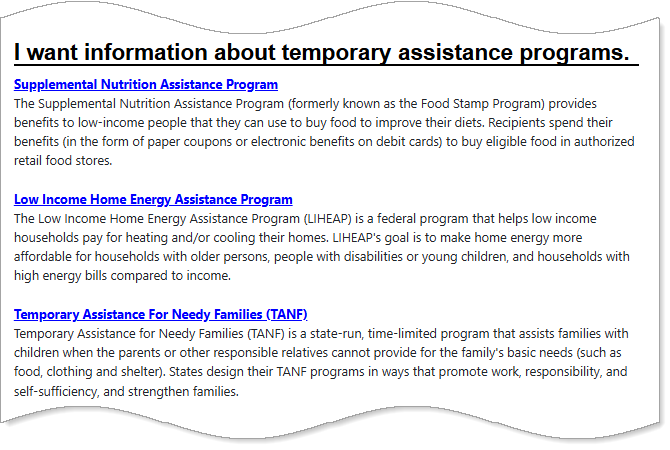
The Community Services page contains information about temporary assistance programs. You can learn about and use links to apply for Supplemental Nutrition Assistance Program (SNAP), Low Income Home Energy Assistance Program (LIHEAP), and Temporary Assistance For Needy Families (TANF). These programs can help you get through a difficult time in your life after job loss , or help support you while you undergo training or a transition.
Temporary Assistance Resources
Where to Find This Feature
-
Left navigation menu > Services for Individuals > Community Services and Benefits > Programs and Services > Temporary Assistance Programs link
-
My Dashboard > Widgets > Community Services and Benefits > Programs and Services link > Temporary Assistance Programs link
-
Directory of Services tab > Services for Individuals > Community Services and Benefits icon > Programs and Services icon> Temporary Assistance Programs link
-
Footer > Services > For Individuals > Community Services and Benefits icon > Programs and Services icon> Temporary Assistance Programs link
Steps to Learn About and Apply for Temporary Assistance Programs
Your site may display different options from those shown here.
Select one of the following links to learn more:
|
Link Title |
Description |
|---|---|
|
Supplemental Nutrition Assistance Program (SNAP) |
SNAP, formerly called Food Stamps, helps people with low incomes buy food until they can support themselves. SNAP’s main goals are to:
It is run by the U.S. Department of Agriculture (USDA). People who qualify get benefits on a special debit card, which they can use to buy approved foods at certain grocery stores. The amount of benefits received depends on how many people are in a household and how much income the household has. |
|
Low Income Home Energy Assistance Program (LIHEAP) |
LIHEAP is a federal program that helps low-income families pay for heating and cooling their homes. Its main goal is to make energy bills more affordable for people who need it most. It does not cover other types of energy usage such as lighting. LIHEAP especially helps:
Each state, tribe, or territory runs its own LIHEAP program, so you must apply where you live. Use the provided contact list or reach out to the National Energy Assistance Referral (NEAR) project as detailed for help applying. The amount of benefits received depends on location, income, heating or cooling costs, family size, and other local rules. |
| Temporary Assistance For Needy Families (TANF) |
Temporary Assistance for Needy Families (TANF) is a program that helps families with children when the parents or caregivers do not have enough money for basic needs like food, clothing, and housing. The main goals of TANF are to:
It is run by each state, so for more details or to apply, contact your state social service agency. Most adults receiving TANF must start working after two years on the program. TANF is time-limited, usually up to a lifetime max of 5 years unless an exception is granted. |